
Auckland FC’s 2025-26 A-League Championship Season In Review
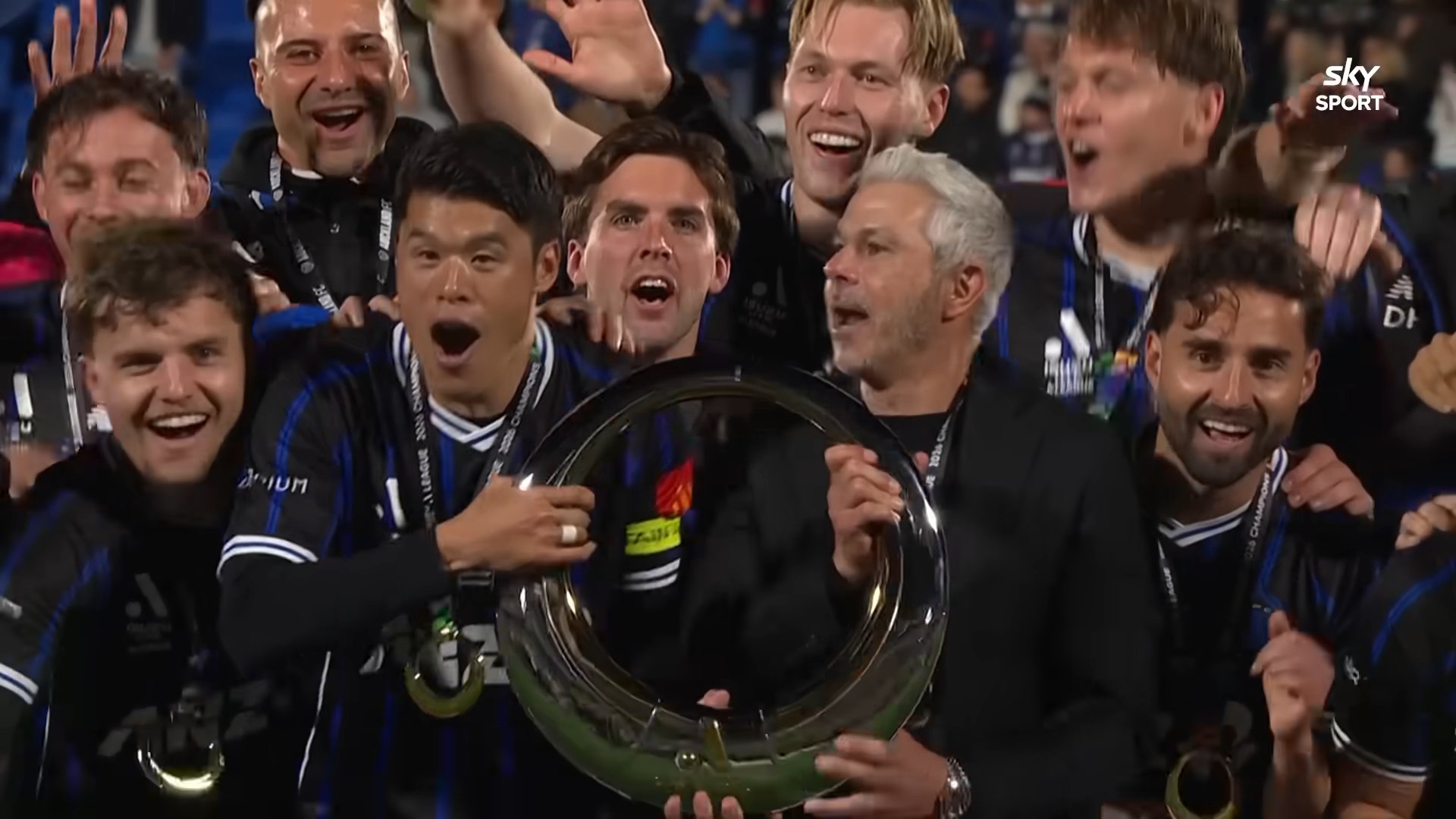
A-League Premiership in year one. A-League Championship in year two. Even a cheeky Oceania Pro League title in there for good measure. It hasn’t taken long for Auckland FC to pack that trophy cabinet full but it’s the ALM Championship that’s the sweetest of the lot, triumphant vindication after slipping up in the finals series last year. Steve Corica kept the core of that squad together but made a few significant additions and this time they did the business when it mattered most... shrugging off some stuttering form leading up to finals to produce exactly what was needed when it was needed. They weren’t necessarily a better team this year than last year but perhaps they were a little smarter, a little more motivated, and a little bit tougher when the pressure was heaviest.
The funny thing about it is that Auckland FC were on a seven-game winless streak when they travelled to Adelaide for the decisive second leg of their semi-final. They’d had a brilliant victory away to Newcastle Jets to seemingly put them back on track to defend their Premiership... only to trip and fall out of the top two entirely with a run of sketchy results. They needed a penalty shootout to advance at home in the elimination final against Melbourne City after conceding an equaliser in second half stoppage time. They only drew at home in the first leg vs Adelaide.
Then they whipped out one of the great performances in this team’s short history as Corica reverted to a back three for the away leg, his team sitting in and soaking up the best that Adelaide had to offer, scoring from a set piece late in the first half, then picking them off a couple more times in the second for a 3-0 win. The grand final turned out to be at home after premiers Newcastle Jets slipped up against Sydney FC and that game was nothing for the neutrals. Very stoic, very stolid game between two supreme defences. AFC kept the back three and allowed Sydney absolutely nothing. Sydney didn’t give them a whole lot either... but a deflected strike from Cam Howieson produced an unlikely hero and some brand new A-League champions.
The Grand Final
Football finals are usually cagey affairs. This one was no exception as two very good defensive teams largely cancelled each other out. Auckland FC did enough to deserve the luck that came their way after an hour when Cam Howieson’s second-phase volley took a deflection that wrong-footed PFA goalkeeper of the year Harrison Devenish-Meares, though they didn’t exactly have an abundance of other chances (Jesse Randall had one chance to ice it and that was about it). But that was more than they allowed Sydney. Dan Hall was superb and Nando Pijnaker not too far behind as Michael Woud was gifted an uneventful evening with the gloves. There were only 13 shots in total in this game. Two on target each. The Expected Goals count was 0.40 vs 0.41. Not a lot of corners either way. Honest, it was a pretty dull contest... and that’s exactly what Auckland FC wanted.
Steve Corica kept the same team that did a job away against Adelaide, including the back three. Against that Adelaide team they’d been able to turn defence into attack by coaxing the Reds forward and then ripping them on the break and from set pieces. Sydney were too good to allow the game to open up like that, turning up with Objective #1 being to frustrate and disarm their hosts – which is not the most exciting approach but you know what? That suited AFC fine. Auckland only kept 38% of possession in that game to mirror the figure from the win vs Adelaide and extend their season’s record to 5-0-0 when they have less than 40% of the ball in a game...
When AFC have over 60% of possession they are 0-2-3 (W-D-L)
When AFC have over 50% of possession they are 2-6-5
When AFC have 50% or less of possession they are 10-5-1
When AFV have 40% of less of possession they are 5-0-0
All season we’d seen tweaks and twists as Corica tried to find consistency in his team’s attack. Sam Cosgrove was signed to be an improved version of Max Mata after MM’s target man presence had brought the best out of Guillermo May... and yet May and Cosgrove struggled to play together. For a while there, Lachlan Brook’s move into the middle seemed to have unlocked a dream team combo of Randall/Brook/Rogerson behind Cosgrove, winning three in a row starting with the second derby... but then they lost badly to Newcastle and went away from that combo. May found some form late in the season. Cosgrove was able to grind away with goals. Jesse Randall’s breakthrough season covered over a lot of the worries (until Francis de Vries got injured and cut off his service)... but the point remains that they never really figured that stuff out.
They didn’t have to. Championships are won on defence and in the two most important games of this team’s existence, Corica leaned all the way into that identity with that back three formation and the rest is history. Two clean sheets, two victories, one championship. During the regular season you’re always looking for ways to improve and it probably wouldn’t have been received very well in the stands if they’d started parking the bus every week. When a grand final swings around though, you’ve simply gotta win by whatever means necessary. If it takes a deflected goal then it takes a deflected goal, all that matters is the result.
Steve Corica knows that – he’s now won three of these things as a coach after winning two of them as a player. Injuries did help force his hand with Felipe Gallegos, Guillermo May, and Jake Brimmer all missing chunks of the finals run... meaning that a back three with Nando Pijnaker returning to the eleven was the best way to maximise the available talent on the pitch. But it’s also true that defence has been at the core of Auckland’s identity from day one and by staying true to that they were able to lift the fabled toilet seat.
Year To Year Comparison
| 2024-25 | 2025-26 | |||
|---|---|---|---|---|
| Stat | ALM Rank | Stat | ALM Rank | |
| Goals Per Game | 1.9 | 6 | 1.6 | 4 |
| Total xG | 42.5 | 6 | 46.5 | 2 |
| Goals Against Per Game | 1.0 | 2 | 1.1 | 2 |
| Total xGA | 30.9 | 2 | 33.5 | 2 |
| Average Possession | 47.7 | 10 | 50.6 | 6 |
| Clean Sheets | 12 | 1 | 7 | 3 |
| xG Differential | 11.6 | 4 | 13.0 | 1 |
| Shots on Target Per Game | 4.8 | 8 | 5.2 | 4 |
| Accurate Crosses Per Game | 5.2 | 3 | 6.2 | 3 |
| Touches in Opposition Box | 678 | 8 | 711 | 5 |
| Set Piece Goals | 19 | 1 | 12 | 1 |
| Interceptions Per Game | 10.2 | 2 | 9.9 | 2 |
| Tackles Per Game | 24.2 | 1 | 19.0 | 1 |
| Clearances Per Game | 29.6 | 1 | 31.2 | 2 |
| Fouls Per Game | 12.1 | 1 | 11.1 | 3 |
There’s nothing there that drastically changed. The main swing is that they evolved into a team that kept a bit more possession, including more touches in the opposition box. That’s down to personnel more than coaching. They lost Alex Paulsen, Neyder Moreno, Tommy Smith, and Max Mata... while adding Lachlan Brook, Sam Cosgrove, and Jake Girdwood-Reich. With Jesse Randall also taking on a bigger role that meant two wingers who loved to dribble and a target man who could hold the ball up. Hence more possession, hence more attacking touches.
Michael Woud stepped into the goalkeeper role and was solid but unspectacular for the first half of the season then had a rough spell in the middle that led to him getting dropped. Oli Sail promptly got injured to give Woud a reprieve... and then bloody hell his form from then onwards was excellent. Easy to forget that Woud was an unpopular figure for much of the season considering how he’s completely turned that reputation around, even earning himself a trip to the World Cup. Woud wasn’t as consistently excellent as Paulsen had been but he kept things going in the right direction and the addition of JGR proved an astute one, helping them cope with a couple of Nando Pijnaker injuries along the way. Not quite as good defensively as they were in year one but much closer to that mark than they ought to have been for a team that no longer had the surprise factor about them.
Lachlan Brook was a slick addition who scored some brilliant goals and provided an extra layer of threat with his free kicks. Much of his work came down the right wing so with Brook as a left-footed RW and with Jesse Randall as a right-footed LW that meant a lot of angling inwards from the width. Plenty of chopping and shooting. Logan Rogerson also alternated on that right side but he experienced a quite big drop-off in production only scoring twice in 1327 minutes after netting nine times in 1797 minutes the season before. Guillermo May didn’t find his scoring touch until late in the regular season and Nando Pijnaker, who’d added four very handy goals from defence last term, didn’t score at all in an injury-riddled campaign. Year one they had 13 different goal scorers, year two they only had nine of them. The overall numbers were similar... but you can see they became much more reliant of a couple of main dudes.
Lachlan Brook scored nine times so he did his bit... but Cosgrove and Randall were the key men on attack. Cosgrove’s aerial threat was a bit overrated and it could be frustrating to see him wrestling with his markers rather than hunting after the ball. However, he was such a pesky presence that nobody could help themselves and the attention he commanded from opposing centre-backs gave AFC something to work with. There are a few things that are undeniable about Mr Cozza: one is that he’s a fighter, even playing through busted ankle ligaments in the finals; two is that he’s a proper poacher with that sneaky knack for being where he needs to be when the ball drops loose in the six-yard box; three is that defenders passionatly hate him... and that nestled nicely within AFC’s rugged personality of play. The goals came consistently – the Englishman never went more than three games without one. The rest of his output grew steadily as the season progressed, figuring out how to play in this system alongside these teammates. By the end his influence in this championship run was irrefutable.
Same goes for Jesse Randall whose career explosion went beyond what anyone anticipated and quickly earned him a move to the Scottish Premiership with Dundee United, along with a spot in the All Whites World Cup squad. He’s quick and nimble, which gave his team a direct outlet in transitional moments. He set up almost as many goals as he scored. His fitness was through the roof, able to keep making those runs throughout (including the defensive tracks that Corica demands – if you’re low on Rogerson because of his lack of goals, that’s understandable, but you’ve also gotta respect how much work he does out of possession).
Randall’s goal-scoring did dry up over the last two months as FDV’s injury removed his best service (and other teams probably adapted to him a bit better) and neither Cosgrove (12 goals from 12.46 xG) nor Randall (9 goals from 9.06 xG) were particularly efficient either. But they were high volume shooters and that’s often more useful. With Randall’s slipperiness and Cosgrove’s physical strength, there were always chances to be had and if you keep shooting then the ball’s bound to go in eventually. Although of course when Auckland needed a goal more than ever it wasn’t Cosgrove or Randall or Brook who provided it... it was Cameron Drew Neru Howieson with his first ALM goal in his 45th appearance. He was saving it up for the right moment, apparently.
Therein lies the skeleton key to Auckland’s success. Only occasionally throughout this season did it feel like Auckland FC were close to their peak but even when they were slogging their way through the mud they always kept it close enough to give themselves a chance. That seven-game winless streak prior to the Adelaide away leg included five draws (one of which was followed by a victorious shootout). They only lost once all season by a multi-goal margin (3-1 vs Newcastle on New Year’s Day), something that happened to them three times in their first season. Another remarkable fact about the Black Knights is that they’ve never lost consecutive games. Auckland may have had a few wobbles trying to protect leads on occasion during the 25-26 campaign but their greatest championship credential is that they were always in the contest. Good days, bad days, doesn’t matter. They were built for the long haul and when the curtain came down they were the last ones still standing.
Respecting the Aotearoa Flavour
There are many lessons to be taken from how Auckland FC went from nothing to everything in the space of two years. One of the most crucial was getting winning A-League experience from their coach (Steve Corica) and football director (Terry McFlynn) with so much of everything else happening downstream from those appointments. Their academy set-up is fascinating, designed very specifically for their region rather with an outside-the-box approach. Having a great home stadium that’s reasonably accessible and not too big or too small, then prioritising the gameday experience for fans also goes hard. And of course there’s the player recruitment.
In their victorious grand final outing, the Auckland FC starting eleven included five New Zealanders, three Australians (one of them also Fijian), a Belgian, an Englishman, and a Japanese captain. Three subs were used and they were all New Zealanders (with a Chilean, an Australian, and two more kiwis left unused). It goes without saying that signing quality imports is crucial for any A-League title run – although it’s fascinating that AFC got away with only using three of them in the final, with Gallegos and May dealing with injuries (Gallegos was on the bench but wasn’t needed). The Aussies Dan Hall, Jake Girdwood-Reich, and Lachlan Brook were each big parts of the success as well... but it’s how they put together their kiwi contingent that’s most educational.
It’s not like they didn’t go after the top tier All Whites – Elijah Just’s name was fed to media a few times – it’s just that those guys were unattainable. They have higher ambitions, they’re mostly already playing at a level beyond the A-League, and even if those other things aligned they probably still couldn’t afford them in a salary capped league compared to the money they’d get elsewhere. There’s a rumour right now that Dan Hall is considering a move to Vietnam which is surely a financial decision and if the Vietnamese league is outbidding the A-League champs then that’s all you need to know.
Which is why the only New Zealand signing they’ve ever made who was an established All Whites international at the time was Nando Pijnaker – and they picked him up from the League of Ireland where his form was awesome but the A-League is a step up from there (context: Moses Dyer left the LOI last year for a big pay-rise in Cambodia). Maybe Tommy Smith too but not really... Smithy had already mostly shifted into non-playing squad member status for the national team when he joined AFC. Others have gotten back into the All Whites on the back of their Auckland form: Francis de Vries, Callan Elliot, Logan Rogerson. Others have have earned debuts as AFC representatives: Jesse Randall and Liam Gillion. Those are things that happened afterwards though - they weren’t on that top shelf when they were recruited to the club.
And they won the A-League that way so it doesn’t even matter. There is strong chat that they’ll be bringing Lachlan Bayliss across the ditch next season but even that would still be an ALM to ALM transfer. Don’t even worry about it. There’s so much depth in kiwi football these days (just look at some of the names who missed out on the World Cup squad) and one of the beauties of having a second A-League club is being able to keep more of them in professional environments. Every single one of the kiwis involved in the final have played NZ National League at some stage except for Michael Woud. Many of them are now dual NZ/AU league champions. Here’s a look at how they all ended up at AFC...
Cam Howieson – Signed after many years running the midfield for Auckland City, winning National League and Oceania Champions League titles and competing at Club World Cups every year. People forget he did play overseas early in his career – in the Burnley academy and for St Mirren in Scotland at a senior level (he once scored a goal against Rangers). Earned a decent number of All Whites caps from that amateur situation. Personal circumstances prevented him from leaving Auckland but fortunately professional football came to him and now he’s the hero of a grand final victory.
Nando Pijnaker – Won a National League with Eastern Suburbs as part of that great generation of Ole Academy players (McCowatt, Just, Parker-Price, etc) and was a standout at NZ age grade levels so was always one on the radar... but struggled to break through in Switzerland, Portugal, and Denmark before finally settling in Ireland and parlaying that into AFC.
Michael Woud – Another one who was a standout at age grade level but had trouble translating that into his club career. Spent time in the Sunderland system before moving to the Netherlands where he played a few games in the Eredivisie with Willem II as a backup and then became a starter for Almere City in the second division. Erratic form cost him his spot there so he moved to Japan where he was mostly a reserve keeper in his 2.5 years there (although did play some AFC Champions League, including a clean sheet against Melbourne City). Was on the bench for every game in year one with AFC. Didn’t fully win the fans over until the last quarter of this campaign... now he’s even earned a World Cup spot.
Callan Elliot – Had some good times at the Wellington Phoenix yet on both occasions that he left to chase overseas opportunities, he failed to debut for either Xanthi (Greece) or Motherwell (Scotland). By the time he debuted for AFC, he’d gone almost 18 months without playing a competitive league game. Was already a capped All White but only recently has he become a regular selection.
Jesse Randall – A highly regarded youngster within the Wellington scene (going to an U17 World Cup in 2019) who bounced around a few different National League teams in order to build up his profile. Had a good year playing for Northern Kentucky University in 2021 and later went back to America in 2023 for his first taste of pro footy... only to barely even get a look in for his USA second tier club. Hence he returned to Wellington Olympic and was awesome again before AFC came calling. Solid rotation player in year one, then exploded as their best and most reliable forward in year two... now is a regular international and will join Dundee United in the Scottish Premiership after the World Cup.
Logan Rogerson – Left the Wellington Phoenix system after making 10 ALM appearances, scoring two goals, but not managing to earn a pro contract. Then embarked on a nomadic overseas career that took him from Germany back to Auckland City to Finland to Armenia and then back to Auckland FC. Debuted for NZ in 2015 but has doubled his cap tally in the past two years since joining AFC (nine caps in nine years, then nine caps in two years).
Francis de Vries – Probably the most significant reputation boost of any of these guys which is why it’s so often overlooked that FDV was starting games in the top division of Swedish football until he busted his ACL in 2022. Of all the guys on this list, he has easily had the most extensive experience above the A-League. But that knee injury really knocked him back and it took a spell at Eastern Suburbs to get his mojo back. Now he’s better than ever.
Liam Gillion – Was thrilling the Auckland City crowd at Kiwitea Street for a couple years as one of the most exciting younger players in the National League before signing his scholarship deal. Started flash for AFC but had trouble with his end product so this season got dropped down to the Pro League team to work on a few aspects. That proved a successful mission as he regained his A-League role for the championship run and could be in line to benefit from Randall’s departure (if he doesn’t leave for something else). Hadn’t played any international footy until the U23s during his Auckland City stuff. Nor had he any professional experience before AFC came calling.
Luka Vicelich – Part of the initial Reserve team intake having previously been in the Auckland City system, in fact he was the youngest player signed to that original squad. He’s since progressed so quickly that he’s made five first team appearances (including two in the finals) by the age of 18. They signed him to a scholarship deal in January. He’s also played at the U17 World Cup.
Van Fitzharris – Only joined the AFC Reserves for the National League phase of the 2025 season after being a regular starter for his hometown Tauranga City throughout the Northern League. Like Vicelich, once they got him in-house they clearly loved what he brought and he’s moved rapidly up the ranks to where he was sitting on the bench for a grand final having gotten on the pitch late in the semi one week earlier. Expect a scholarship to come his way soon.
That’s ten players. Two of them are teenagers signed originally to the Reserve team who developed fast enough to already be in the first team framework (Vicelich, Fitzharris). Two were capped All Whites playing in the NZ National League at the time (Howieson, De Vries) while another two were uncapped younger National League standouts (Randall, Gillion). The other four were capped All Whites playing either in lesser situations overseas (Rogerson, Pijnaker) or good situations where they were out of favour (Woud, Elliot). Every one of them is a superior player now to when they first joined AFC. Every one of them has improved their standing with the All Whites. Every one of them is now an A-League champion. We don’t need AFC to even bother chasing any first-choice All Whites because they’ve shown that with the opportunities they offer to established players and the development they’re providing for younger players they can create new (or reinvigorate old) All Whites.
The Crowds
Here’s a great example of the ‘Two Things Can Be True’ theory because on the one hand, Auckland FC’s crowds dropped of substantially in their second campaign. Without the gloss of newness, fresh out of the packet, AFC’s turn-up at Mt Smart fell by 24%. That was a plummet from last season to this season beaten only by their mates at the Wellington Phoenix (down 29%... in large part because their home derby crowd was too depressed to turn up). That was always going to be the case to some extent but it feels safe to say Auckland would not have expected that number to fall quite as steeply as it did.
It wasn’t only the freshness factor. To be honest, much of it the drop-off was probably down to the fact that they weren’t playing very well in those home games. People aren’t going to be sitting on the train (or idling in their cars trying to escape stadium traffic) all fizzed up for the next one if the lads just lost 3-1 to a rampant Newcastle team, or drew 2-2 with Central Coast because their goalkeeper fumbled an easy one, or got dropped 2-1 by Macarthur, et cetera. The numbers are also skewed by only having one home derby compared to two the year before. But the bottom line is they went from an average home crowd of 18,890 to an average home crowd of 14,310.
Auckland FC at Home in 2025-26:
6 Wins | 6 Draws | 4 Losses | 23 Goals For | 19 Goals Against | +4 Goal Difference
Auckland FC Away in 2025-26
7 Wins | 5 Draws | 2 Losses | 25 Goals For | 12 Goals Against | +13 Goal Difference
On the other hand, Auckland FC still propped up the entire competition for attendance because that 14.3k they drew per game was the highest figure in the A-League. Same as that 18.9k had been the year before. Things were looking dicey when they only drew 11k to a home elimination final but momentum grew from there and they ended up with a sold out above-capacity grand final even though that game was scheduled at one week’s notice. Not quite a record attendance since they had more time to prepare for the elimination final vs Melbourne Victory last season... but close enough. If there was room they probably could have solid it out twice over given how fast those tickets were snapped up.
Auckland FC were the only team who never had a home crowd below 8k in 2025-26... in fact they never even went below 10k. Their worst home crowd was better than the best home crowd for either Brisbane Roar or Macarthur FC... and the only reason the Wellington Phoenix aren’t also on that list is because they drew 12k to the derby against Auckland back in November.
AFC Finals Series Crowds...
11,351 vs Melbourne City (Elimination Final)
16,903 vs Adelaide Utd (Semi-Final First Leg)
28,374 vs Sydney FC (Grand Final)
Where To From Here?
Auckland FC won the A-League and then celebrated it like you’re supposed to. There was a parade down Queen Street and everything. Glorious stuff. Then a handful of their players dusted themselves off and jumped on a plane to link up with the All Whites in Florida ahead of the World Cup and attention moved elsewhere. AFC fell short in their first finals run then channelled that into success the next time around. What do you do when you’ve reached the top of the mountain? You go climb it again.
There are some complications though. Most of the contracts they handed out in year one – when the team was brand new and players were effectively taking a leap into the unknown – were two year contracts. Those deals are now ending which leaves AFC with a huge chunk of their squad as impending free agents at a time when the A-League is coincidentally shifting to a hard cap without concessions or exemptions beyond being allowed to sign exactly one marquee player who sits outside the AU$3million limit.
As has been publicised, Auckland were given extra exemptions as an expansion club that are now coming to an end... though that stuff often seems to get misinterpreted. The exemptions they were given, same as every other recent expansion team in recent years, were to compensate for being not being able to access other exemptions like loyalty or homegrown player discounts (seeing as an expansion team by definition cannot have loyalty or homegrown players yet). They were compensations not advantages. RNZ did claim that “it's believed Auckland FC have spent nearly twice as much as the Wellington Phoenix on their squad over the past two seasons” but, like, about 30% of the Nix squad last season were academy grads aged 22 or younger so they weren’t exactly busting the banks over there (although mid-season additions would have helped close the gap – Tuiloma, Singh, Kartum).
Not sure if Hiroki Sakai counts as a marquee player or not, either way he gave everyone at the club a boost back in April when he signed a one-year extension to stick around until he’s 37 years old (at least). That’s one import sorted. Other than that it’s a pretty bare cupboard, to be honest. Logan Rogerson signed a two-year extension before this season so he’s got another. Francis de Vries signed on for three more years in January. Luke Vicelich was also given a three-year scholarship deal in January. Jake Brimmer (two years), Nando Pijnaker (one year), Callan Elliot (one year), and Michael Woud (one year) all have time remaining on their original deals which is fair reward for being the keen beans who jumped on multi-year deals from the outset. Cam Howieson has signed an extension since the season ended. So has Woud even though he was already contracted. Everyone else is up for grabs.
Contracted: Logan Rogerson, Jake Brimmer, Nando Pijnaker, Francis de Vries, Hiroki Sakai, Callan Elliot, Michael Woud, Luka Vicelich, Cam Howieson
Off Contract: Oli Sail, Guillermo May, Louis Verstraete, Felipe Gallegos, Jesse Randall, Marlee Francois, Dan Hall, Lachlan Brook, Jake Girdwood-Reich, Sam Cosgrove, James Hilton, Liam Gillion
We already know that Jesse Randall has signed with Dundee United on a free transfer and will be linking up with them after the World Cup. Jake Girdwood-Reich was only at the club on loan from St Louis City where he has one more year remaining. They might be able to do something there but it’d take some manoeuvring. At the time of writing, there have also been reports linking both Dan Hall and Liam Gillion to situations elsewhere. However it has been strongly reported that AFC are in prime position to scoop up Lachlan Bayliss after he departed the Newcastle Jets following his breakthrough season. His brother James already plays for the AFC Pro League team.
All of their non-Vicelich scholars are off contract too... with Adama Coulibaly and Finn McKenlay confirmed to be leaving. Both played A-League in their first year but weren’t really in the frame this time around although McKenlay did get onto the bench for four of the last six games when injuries struck their midfield (including the first two finals games). Coulibaly’s problem is that he’s so versatile that it’s been hard to nail down a position even as he’s mostly stuck to left-back and centre-back within the AFC system. He did get some OPL appearances late in that campaign but perhaps lacks the size for a Steve Corica backline. McKenlay doesn’t lack size and was arguably the best player for the Reserves in National League... bit of a shame to see him leave, though perhaps he just didn’t want to stick competing for a seat on the bench for another year. Hard to say until we see where they end up. James Hilton was also released in the same announcement, less of a surprise given that he was only a mid-season injury replacement.
Other Bits and Pieces
| APP | MIN | G | A | YC | RC | |
|---|---|---|---|---|---|---|
| Dan Hall | 29 | 2599 | 3 | 1 | ||
| Michael Woud | 28 | 2481 | 2 | |||
| Jesse Randall | 30 | 2476 | 9 | 8 | 2 | |
| Jake Girdwood-Reich | 29 | 2442 | 2 | 3 | ||
| Louis Verstraete | 28 | 2301 | 2 | 3 | 8 | |
| Sam Cosgrove | 29 | 2254 | 12 | 4 | 8 | |
| Lachlan Brook | 30 | 2075 | 9 | 2 | 5 | |
| Francis De Vries | 25 | 2023 | 1 | 7 | 2 | |
| Callan Elliot | 27 | 1743 | 1 | 2 | ||
| Hiroki Sakai | 22 | 1566 | 2 | 5 | ||
| Guillermo May | 26 | 1528 | 6 | 4 | 3 | |
| Felipe Gallegos | 24 | 1370 | 1 | 1 | 3 | |
| Logan Rogerson | 28 | 1327 | 2 | 1 | 1 | 1 |
| Cam Howieson | 25 | 1097 | 1 | 1 | 3 | |
| Nando Pijnaker | 17 | 968 | 1 | |||
| Jake Brimmer | 16 | 744 | 2 | |||
| Marlee Francois | 13 | 319 | 2 | |||
| Jimmy Hilton | 2 | 180 | ||||
| Liam Gillion | 9 | 144 | 1 | |||
| Luka Vicelich | 5 | 143 | ||||
| Jonty Bidois | 10 | 111 | 1 | |||
| Oli Sail | 1 | 69 | ||||
| Van Fitzharris | 3 | 48 | ||||
| Bailey Ferguson | 2 | 19 | ||||
| James Mitchell | 2 | 11 | ||||
| Oliver Middleton | 1 | 7 | ||||
| Ryan Mackay | 1 | 4 |
Jesse Randall was the only player to start all 30 games
Lachlan Brook was the only other player to appear in all 30 games
Girdwood-Reich, Cosgrove & Hall each made 29 appearances
All-Time ALM Appearances for Auckland:
Logan Rogerson - 56 games (11 goals)
Guillermo May - 54 (15)
Francis de Vries - 53 (3)
Louis Verstraete - 53 (4)
Felipe Gallegos - 51 (2)
Jesse Randall - 50 (12)
Hiroki Sakai - 47 (3)
Callan Elliot - 47 (1)
Cam Howieson - 45 (1)
Dan Hall - 44 (0)
Nando Pijnaker - 44 (4)
Jake Brimmer - 43 (3)
Cam Howieson’s career in snapshot:
Represented Aotearoa at U17 World Cup, U20 World Cup, and Olympic Games (U23s)
Debuted for All Whites at 17 years and 4 months in May 2012 and has earned 21 senior caps, appearing under each of the past five permanent coaches (Herbert, Hudson, Schmid, Hay & Bazeley)
Joined Burnley on a scholarship as a teenager and made two league appearances for them in the EFL Championship. Also spent time with Doncaster Rovers on loan before joining St Mirren where he scored on his league debut (against Rangers, no less).
After a stint with Team Wellington, he joined Auckland City in 2017 and spent seven years there during which time he did all this:
Three NZ Premiership/National League championships (2018, 2020, 2022)
Three NZ Premiership/National League runners-up (2017, 2021, 2023)
Four OFC Champions League titles (2017, 2022, 2023, 2024)
One Chatham Cup title (2022)
192 games played, 42 goals scored
Now he's won an A-League Premiership (2024-25) and an A-League Championship (2025-26) with Auckland FC, scoring the winning goal in the final and being awarded the Joe Marston Medal for Player of the Game - the first NZer to ever win that award.
U21 A-League Debutants This Season
Oli Middleton, Bailey Ferguson, James Mitchell, Ryan McKay, Luka Vicelich, Van Fitzharris
AFC U21s Minutes in Year One: 64 mins (0.25%) - McKenlay (47), Bidois (9), Coulibaly (8)
AFC U21s Minutes in Year Two: 343 (1.15%) - Vicelich (143), Bidois (111), Fitzharris (48), Ferguson (19), Mitchell (11), Middleton (7), Mackay (4)
AFC Elevators
Played For All Three AFC Teams: Luka Vicelich, Van Fitzharris, Adama Coulibaly, Jonty Bidois, Bailey Ferguson
Played ALM & Pro League: Liam Gillion
Played ALM & Reserves: Finn McKenlay, Oli Middleton, James Mitchell, Ryan McKay, Oli Sail, Nando Pijnaker
Played Reserves & Pro League: Isa Prins, Everton O’Leary, Aston Burns, Blake Callinan, Dejaun Naidoo, Eli Jones
Sam Cosgrove was Auckland's Top Scorer with 12 goals:
35 shots from headers (4 goals from 4.39 xG)
39 shots from with feet/other (8 goals from 8.08 xG)
Cosgrove's goals by minute scored:
1', 6', 7', 15', 20', 25', 34', 45+4', 52', 58', 58', 58'
Cosgrove never scored in the last half hour of a game... although on six different occasions he scored the opening goal in a game.
Auckland FC When They Score First
2025-26: 13 wins – 5 draws – 2 losses
2024-25: 16 wins – 4 draws – 0 losses
Auckland FC When They Concede First
2025-26: 0 wins – 5 draws – 4 losses
2024-25: 0 wins – 3 draws – 4 losses
There have also been two 0-0 draws in their history.
Auckland FC have never won after conceding the first goal... but also Auckland FC have only conceded the first goal on 16/58 occasions (28%).
The Niche Cache is largely funded by the kind souls who dig our work and support us financially on Patreon, Substack, or Buy Me A Coffee – if you reckon that sounds like you then please get amongst, many churs
Also helps to whack an ad, tell your mates about us, and do them like/comment/share things that the algorithms demand